Style guide, Uniforms
Chef Coat Styles Explained: Double vs Single Breasted, Sleeves, Collars, Piping, Studs vs Buttons, and Which to Pick for Your Kitchen
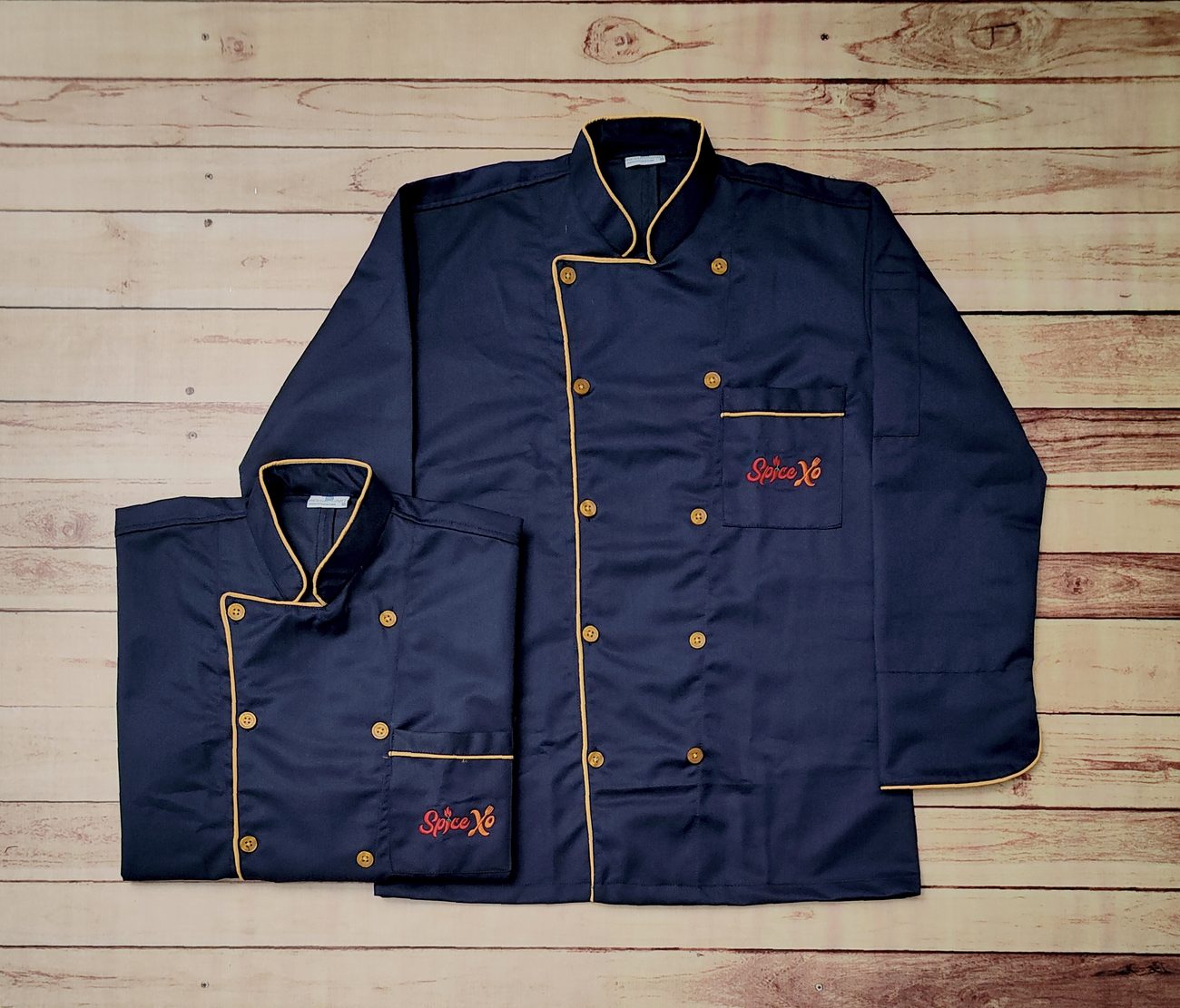
Chef coat styles look similar from across a room, but the details decide whether a coat is comfortable at the tandoor, practical in a commercial laundry, or sharp enough for a chef's table. Double or single breasted, half or full sleeve, stand collar or mandarin, contrast piping, press studs or buttons: each choice changes how the coat works during a twelve-hour shift.
This guide explains each chef coat style, what it is good at, and which combination suits which kitchen. It is written from the manufacturing side: these are the questions we ask every client before we draw a mockup.
Double-breasted vs single-breasted chef coats
The front closure is the first decision, and it shapes everything else.
Double-breasted
The classic chef coat has two columns of buttons or studs and a front panel that overlaps across the chest. The overlap gives two layers of fabric over the torso, a little extra protection from heat and splashes, and a useful trick: the front can be closed the other way to hide a stain before the chef steps out to a table. It looks formal and trained, which is why head chefs, hotel kitchens and fine-dining restaurants tend to keep it.
The downside is warmth. Two layers over the chest are noticeable in a poorly ventilated Indian kitchen in May.
Single-breasted and offset fronts
A single-breasted coat has one column of closures down the centre or slightly off-centre. The offset version, where the placket sits to one side, keeps some of the chef look while dropping the second layer. These coats are lighter, quicker to put on and cheaper to make, and they suit busy line cooks, cloud kitchens, cafes and QSR kitchens.
Concealed placket
Here the studs or buttons hide under a fold of fabric, giving a clean front with no visible hardware. It looks modern and minimal, and suits open kitchens and brands with a sleek identity.
| Front style | Best for | Watch out for |
|---|---|---|
| Double-breasted | Head chefs, hotels, fine dining, chef's tables | Warmer; more buttons to maintain |
| Single-breasted, centre | Line cooks, QSR, cloud kitchens | Less protection; stains cannot be hidden |
| Single-breasted, offset | Most restaurant kitchens; a good all-rounder | Check the overlap is wide enough to protect |
| Concealed placket | Open kitchens, modern and minimal brands | Slightly slower to open in an emergency |
Half sleeve vs full sleeve
Sleeve length is the choice that most affects comfort in Indian kitchens.
Full sleeves protect the forearms from oil splatter, steam, grill heat and tandoor walls. They also look sharper at the pass. Most full-sleeve coats have a turn-back cuff so the chef can roll the sleeve up neatly without the coat looking untidy.
Half sleeves are cooler, make hand-washing easier, and keep cuffs out of dough and batter. They are standard in bakeries, pastry kitchens, cafes and many hot Indian kitchens where the line has little ventilation.
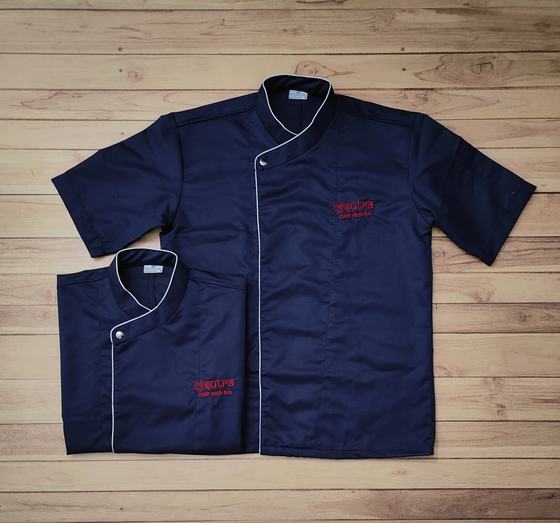
A common pattern is full sleeves for the head chef and grill, tandoor and fry stations, and half sleeves for prep, pastry and cold sections. If heat is your main concern, our guide to keeping cooks cool in Indian summers goes deeper into fabric and ventilation.
Collars: stand, mandarin, contrast and wrap
Almost every chef coat has a short upright collar. It keeps the neck clean, sits comfortably under a neckerchief, and does not flap into food. The variations are about height, shape and colour.
- Stand collar: straight and structured, usually around 3 to 4 cm high. The standard for most kitchens.
- Mandarin collar: slightly lower with rounded front edges. Softer and a little more casual.
- Contrast collar: the collar in a second colour, such as white on maroon, black on white, or brand colour on black. It is the simplest way to add brand identity without changing the coat body.
- Wrap or kimono-style collar: a contrast band that runs from the collar down the front, borrowed from Japanese workwear. It suits pan-Asian and sushi kitchens and modern open kitchens.
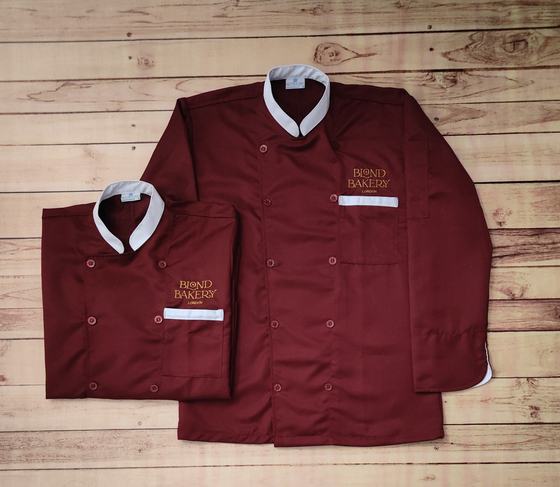
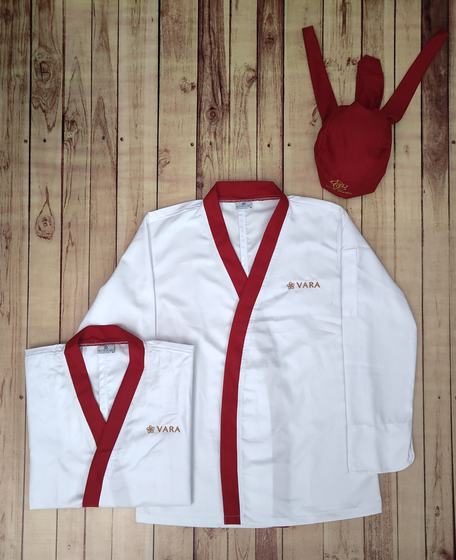
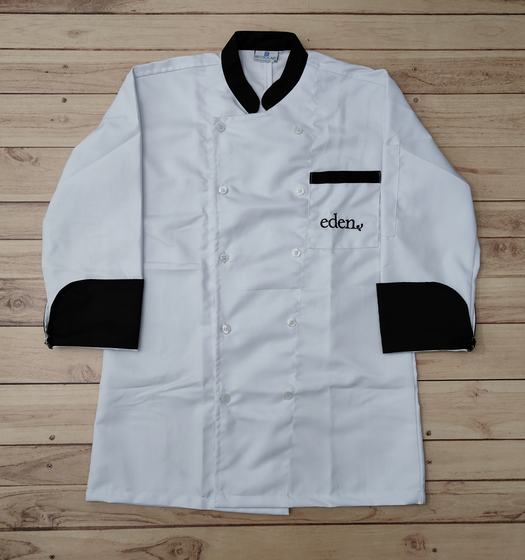
Ask for the collar to be lined with a soft, breathable fabric. A stiff interlining that looks crisp on a hanger can rub the neck raw by the end of a long shift.
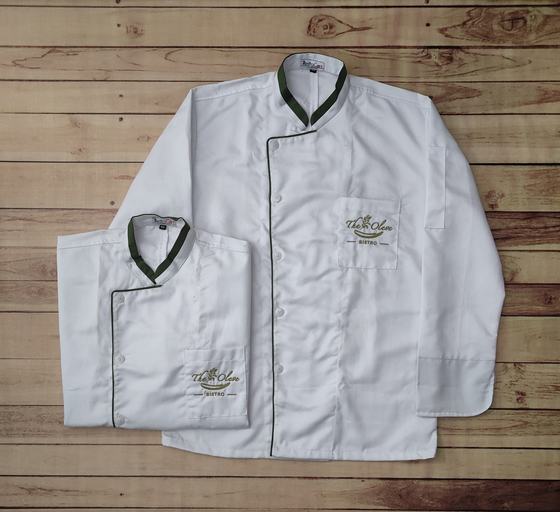
Contrast piping and colour accents
Piping is a thin corded trim sewn into the seams, usually along the collar, placket, cuffs or pockets. It is the most economical way to turn a plain coat into a branded one, and it is very effective at separating roles: gold piping for senior chefs, red for the line, and so on. We cover this in detail in our guide to differentiating kitchen uniforms by rank.
Some practical notes on piping:
- Use colour-fast piping. A red piping that bleeds on a white coat after the first hot wash ruins the whole garment.
- One or two piping lines look deliberate. Piping on every seam looks busy.
- On darker coats, a lighter piping (white, gold, tan) shows up better than a dark one.
- Other accents that work: contrast cuffs, a contrast shoulder yoke, coloured studs, or a contrast pocket flap.
Coat colour: white, black and everything in between
White is still the classic chef coat colour for good reasons: it signals cleanliness, it can be bleached, and soiling is visible, so coats get changed when they should. It is the default for hotels, bakeries, central kitchens and any kitchen that faces regular hygiene audits.
Black and charcoal coats have become the standard in open kitchens, cafes, bars and QSR because they hide stains between washes and look modern. They fade with repeated hot washing, so choose a colour-fast fabric and expect to replace them a little sooner than white. Brand colours such as maroon, navy, bottle green, olive, mustard or brown are increasingly common, especially where the kitchen is part of the dining room. Our uniform colours guide explains how coat colour, cuisine and restaurant lighting interact.
Not sure which style fits your kitchen? Tell us your cuisine, stations and team size. We will suggest a coat style for each role and send mockups.
WhatsApp +91 98213 34906 Email info@restrocart.comPress studs vs buttons
The closures are small, but they are the part of a chef coat that fails first.
| Closure | Strengths | Weaknesses | Suits |
|---|---|---|---|
| Metal press studs | Fast to open, hard to lose, survive commercial laundry | Can rust if cheap; need a reinforced facing | Most kitchens, denim coats, busy lines |
| Plastic or resin studs | Light, no rust, economical | Can crack in very hot washes | Cafes, QSR, cloud kitchens |
| Cloth knot buttons | Traditional, elegant | Come loose; slower to fasten | Fine dining, hotels, head chefs |
| Standard sewn buttons | Easy to replace, flexible styling | Fall off in hard laundering | Budget coats, service-style chef shirts |
| Removable stud buttons | Take out before washing; swap colours by role | Small parts get lost | Hotels and brigades with rank colours |
If your coats go to a commercial laundry, press studs are almost always the better choice. If staff wash at home and the kitchen is guest-facing, knot buttons are fine for senior chefs.
Pockets, vents and the small details
Details worth specifying on any chef coat
- A pen and thermometer pocket on the left sleeve, sized for a probe thermometer.
- One chest pocket for a notepad or phone; avoid large lower pockets that snag.
- Side vents at the hem so the coat does not ride up when the chef bends.
- Underarm eyelets or a breathable back panel for hot kitchens.
- A hanging loop inside the collar for lockers.
- Embroidery on the chest, sleeve or back, sized so it does not stiffen the fabric. Name or designation above the pocket if you want it.
- A consistent size chart across styles, so a chef who wears a Large in one style fits a Large in another.
Fits: classic, tailored and ladies' cuts
A classic chef coat is cut generously for movement and ventilation. A tailored or slim-fit coat looks sharper in an open kitchen but can feel restrictive at the stove. Ask for a ladies' fit for women chefs: a coat graded properly for shoulders, bust and sleeve length, not just a smaller men's coat. Our uniform sizing guide explains how we size mixed teams.
Which chef coat style for which kitchen
Putting it together, here is where we usually start with clients:
| Kitchen type | Suggested style |
|---|---|
| Fine dining and chef's table | Double-breasted, full sleeve, knot buttons or concealed placket, subtle piping |
| Hotel kitchen or banquet brigade | Double-breasted for senior chefs; single-breasted for the line; rank colours by piping or studs |
| North Indian with tandoor | Full sleeve for tandoor and grill; lightweight poly-cotton; press studs |
| Cafe or all-day kitchen | Offset single-breasted, half sleeve, contrast collar in brand colour |
| Bakery or patisserie | Half sleeve, white or light colours, press studs, minimal pockets |
| Pan-Asian or sushi counter | Wrap-style contrast collar or kimono-style front, half or three-quarter sleeve |
| Open kitchen, modern bistro | Concealed placket or denim, embroidered back branding |
| QSR, cloud kitchen, high volume | Single-breasted, half sleeve, or a chef t-shirt with apron |
If denim appeals for an open kitchen, see our denim chef coats guide first; it explains where denim works and where it does not. For base fabrics and GSM, see our chef coat fabric guide. You can browse finished coats in every style on our chef coats gallery.
How we turn a style choice into a finished coat
At RestroCart, our design team turns your style choices into mockups per role, with fabric, piping and embroidery placement marked. We send physical fabric swatches, then one complete sample coat per style for you to try in your kitchen. Production starts only after you approve the sample. Typical timelines are two to three weeks for design and sampling and two to four weeks for production, and we deliver anywhere in India, packed by role and size. Your pattern, fabric codes and embroidery files stay on file for reorders.
Ready to finalise your chef coats? Send your roles, headcount, logo and deadline. We will reply with style suggestions, fabrics and a timeline.
WhatsApp +91 98213 34906 Email info@restrocart.comGet a quote for custom chef coats
The best chef coat is the one your team forgets they are wearing until a guest compliments it. Tell us how your kitchen works and we will suggest the right style for each role. Message us on WhatsApp at +91 98213 34906 or use our quote builder to list the pieces you need.
See the real thing: 44 chef caps we have made · 9 denim chef coats we have made