Buying guide, Tableware
Printing Paper Menus for Restaurants: Paper Types, GSM, Lamination, Sizes, Folds and Reprint Cycles
Paper menu printing looks like the easy part of opening a restaurant. It rarely is. The same menu printed on the wrong paper curls in a humid kitchen, frays at the corners by the second week, or shows every oily fingerprint under warm lighting. Printed on the right stock, with the right finish and fold, it lasts as long as it needs to and costs little to replace.
This guide is for restaurant owners, cafe founders and managers printing menus in India: which paper types and GSM to choose, when to laminate, standard sizes and folds, how to plan reprints, and how paper works with MDF boards and clipboards or leatherette covers. At RestroCart we print menus and inserts alongside the boards and covers they go into, so the advice below comes from seeing both sides.
When paper is the right menu, and when it is not
Paper is the right choice when your menu changes often, when you run a QSR or delivery-led kitchen, when you need a menu for an event or pop-up, and as the insert inside almost every board or cover. It is fast to reprint, cheap per piece, and lets you test prices and dishes without committing to hardware.
Paper on its own is the wrong choice for a permanent table menu in a busy dining room. An unlaminated card in daily service looks tired within weeks. If you want the menu itself to last, put the paper in something: a clipboard, a screw-post board, a cover. The paper then does what it is good at, carrying information that changes, and the board or cover does the rest.
Paper types and GSM, explained
GSM means grams per square metre: the weight of the paper, and a rough guide to its thickness and stiffness. Higher GSM is stiffer, not automatically better. The right weight depends on how the menu is held and how long it must last.
| Paper type | Typical weight | Feel and finish | Best use |
|---|---|---|---|
| Uncoated paper (maplitho, bond) | About 80 to 130 GSM | Matte, writable, slightly absorbent | Daily specials, newspaper-style menus, order sheets |
| Art paper (gloss or matte coated) | About 130 to 170 GSM | Smooth, sharp colour | Inserts in sleeves, booklet inner pages, flyers |
| Heavier art paper or light card | About 200 to 250 GSM | Firm but flexible | Inserts for clipboards, screw posts and rings |
| Art card | About 300 to 350 GSM | Stiff, stands on its own | Standalone menu cards, covers, tent cards |
| Textured or kraft card | About 250 to 350 GSM | Natural, tactile, less colour-accurate | Cafes, bakeries, organic or rustic concepts |
| Non-tearable synthetic | Measured in microns | Waterproof, wipeable, tear-resistant | Single-sheet menus in bars, outdoor seating, busy casual dining |
Two practical notes. First, coated papers print colour and photographs more sharply; uncoated papers feel warmer and can be written on, which matters if staff mark specials by hand. Second, textured and kraft stocks look beautiful but can dull colours and fine type, so test your menu on them before committing a whole run.
Lamination and coatings
Lamination is a thin plastic film applied to the printed sheet. It protects against spills and fingerprints, stiffens the menu and makes it wipeable. The main choices:
- Gloss lamination. Bright colours and a shiny surface. It shows glare under spotlights and fingerprints more readily, so it suits bright, casual concepts more than dim dining rooms.
- Matte lamination. The safe default for restaurants. Low glare, easy to read under warm lighting, and it hides fingerprints better.
- Soft-touch or velvet lamination. A smooth, slightly suede feel that reads as premium in the hand. Lovely for covers and short menus, though it marks more easily than standard matte in heavy use.
- Spot UV. A glossy coat applied only to parts of the design, such as the logo, for contrast on a matte menu.
- No lamination. Right for daily sheets, menus guests write on, and anything you will reprint in a few days.
A laminated menu can be wiped with a damp cloth and mild detergent. Test your sanitiser on one menu before using it on the full set, since some solvents can cloud or lift films over time.
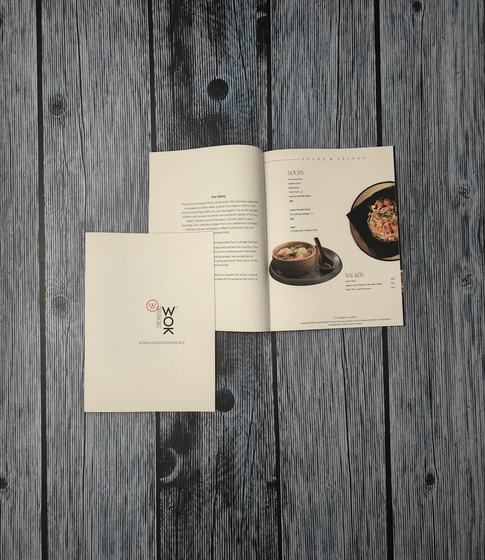
Standard sizes and folds
Start with size, because it decides the printing cost, the hardware and how the menu reads at the table.
| Format | Panels or pages | Good for |
|---|---|---|
| A4 single sheet | 1 or 2 sides | Clipboards, boards, most cafe and casual menus |
| A5 single sheet | 1 or 2 sides | Dessert, coffee and bar menus, small tables |
| Tall narrow (about 4 x 9 inches) | 1 or 2 sides | Cocktail lists, specials, drinks menus |
| A3 folded to A4 (bi-fold) | 4 pages | Full menus that need structure without binding |
| Tri-fold or Z-fold | 6 panels | Takeaway and delivery menus, compact full menus |
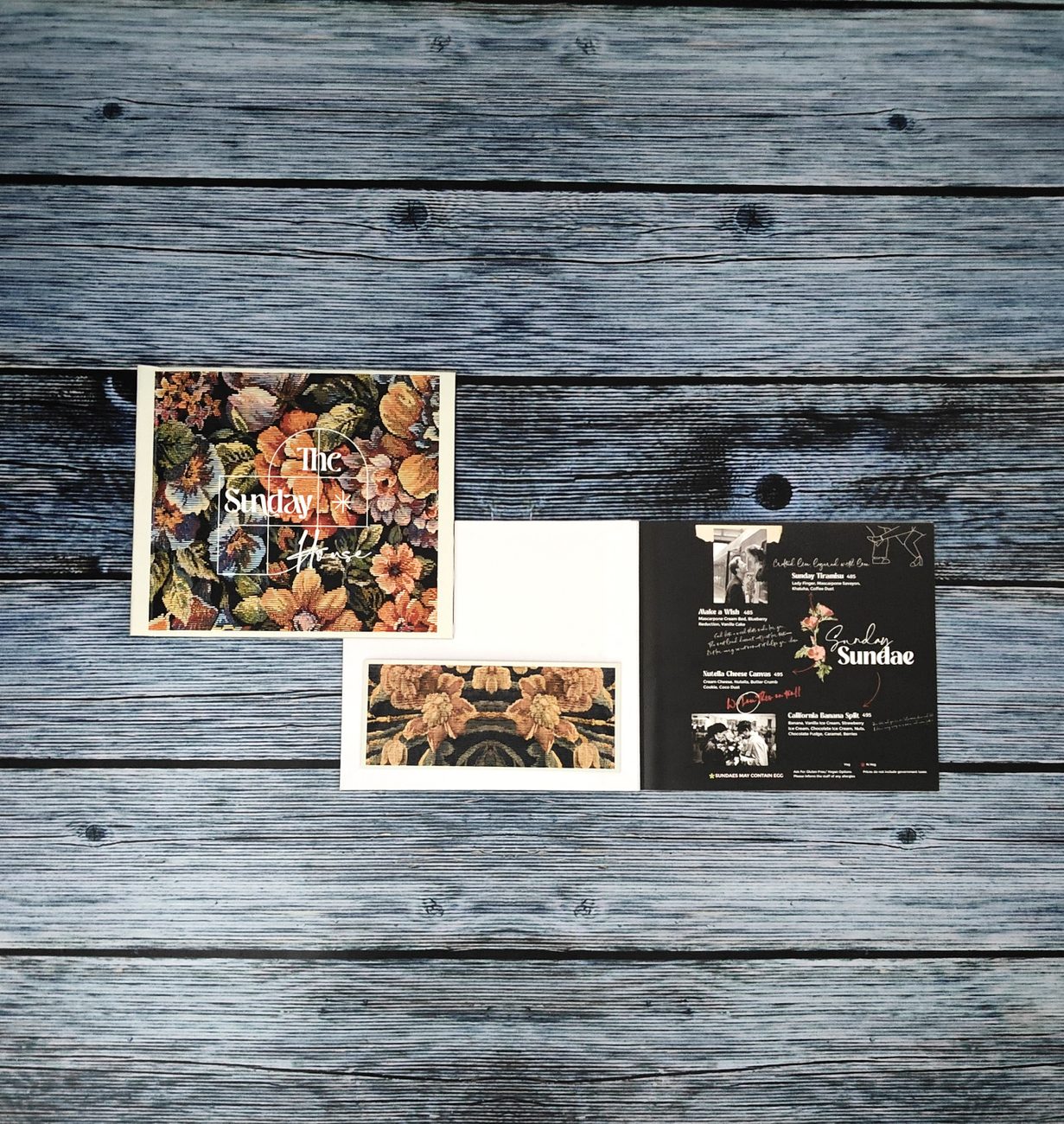
| Gatefold | Doors that open to a centre spread | Tasting menus, launches, statement menus |
| Saddle-stitched booklet | Pages in multiples of four | Long menus with photography |
| Square | 1 or 2 sides, or folded | Distinctive cafe and dessert menus |
Folded menus need a scored fold on anything above about 170 GSM, otherwise the fold cracks, especially through dark ink. If you want a fold to survive daily use, laminate before folding and ask your printer to crease properly.
Printing a new paper menu? Send your menu file, size and how many you need. We will suggest the paper, lamination and fold, and quote for the first run and reprints.
WhatsApp +91 98213 34906 Email info@restrocart.comDesigning a menu that prints well
A menu that looks perfect on a laptop can print poorly. These are the checks we run on every file before printing:
- Bleed and safe margins. Extend background colours about 3 mm past the trim line, and keep text well inside it, especially near punch holes and screw posts.
- Colour mode and resolution. Send print files in CMYK with images at print resolution. Brand colours on screen and on paper are never identical, so ask for a printed proof if the colour matters.
- Type size and contrast. Restaurants are dim. Keep dish names clearly legible and descriptions no smaller than a comfortable reading size, with strong contrast. Thin light-grey text on cream stock is the most common legibility mistake.
- Dietary markers. Use the veg and non-veg symbols guests expect, placed consistently, plus clear allergen or spice notes.
- Prices aligned. Keep prices in one consistent position so a price revision is a clean text change, not a redesign.
- A version code. Put a tiny date or version on the back so staff can tell the current menu from an old one.
Planning reprint cycles
Every paper menu is a consumable. The smart move is to plan how often each part will change and print accordingly, instead of reprinting everything whenever one price moves.
| Menu part | Typical change cycle | Printing approach |
|---|---|---|
| Brand cover or board | Rarely | Engraved or printed once on a board or cover; not paper |
| Core food and drinks menu | When prices or dishes change | Insert on 170 to 250 GSM or laminated card; moderate runs |
| Seasonal or chef's selection | Monthly or seasonally | Separate sheet or card; smaller runs |
| Daily or weekly specials | Daily to weekly | Uncoated sheets, unlaminated; short runs or in-house printing |
| Takeaway and delivery menus | When prices change | Tri-fold on lighter stock; larger runs |
For quantities, count tables and seats, then add a buffer for spills, damage and busy nights. Larger runs are cheaper per piece, but a large run of a menu whose prices will change next month is not a saving. For a new restaurant, print a modest first run of the core menu, watch what sells and what guests ask about for a few weeks, then print a larger second run with corrections.
Pairing paper with boards, clipboards and covers
Most restaurant menus are paper inside something else. The paper choice depends on what that something is.
- Clipboards: one or two sheets, 200 to 350 GSM, laminated if the sheet will be used for more than a week. Too-light paper curls away from the board.
- Screw-post boards and hinged boards: 170 to 250 GSM, punched to match the posts exactly. Keep the punch template with your print files.
- Ring-bound boards and paddles: heavier paper, or reinforced holes, because pages turn on the rings all day.
- Leatherette covers: sheets held by elastic, corners or sleeves; lighter paper works because the cover protects it.
- Sunboard boards: the print is usually mounted or printed directly, so a change means a new board. See our sunboard menu boards guide.
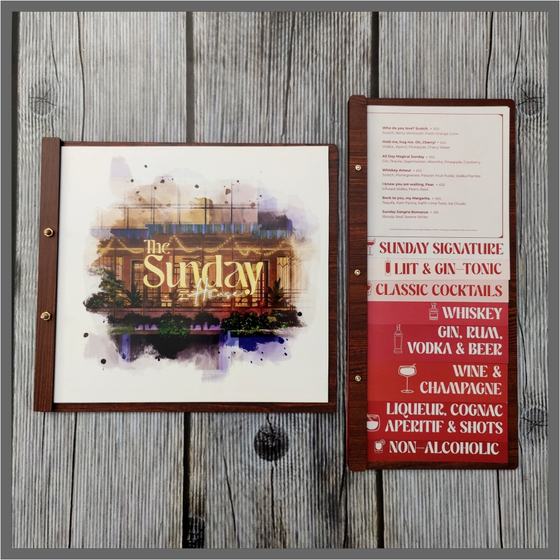
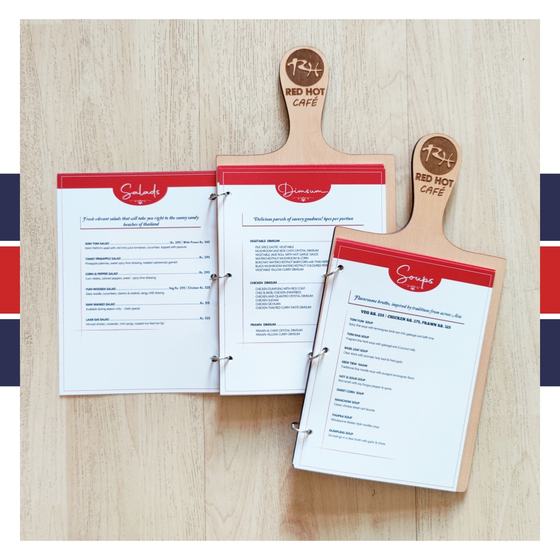
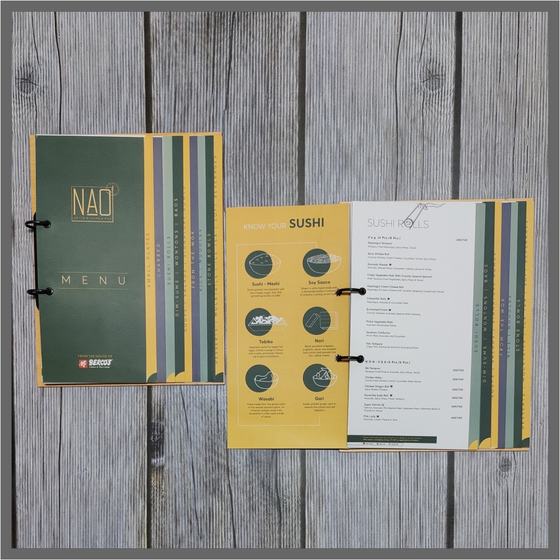
If you are also planning bill folders, coasters and table cards, keep the same paper, colours and typography across them. Our guide to restaurant stickers, thank-you cards and stationery covers the smaller printed pieces.
A print-ready checklist
Before you approve a menu print run
- Final prices and dish names checked by the chef and the owner, not just the designer.
- Size matches your boards, clipboards or covers, including punch or post positions.
- Paper type and GSM agreed for each part of the menu.
- Lamination type agreed, or a clear decision not to laminate.
- Bleed, safe margins and folds checked on a printed proof.
- Veg, non-veg and allergen markers consistent throughout.
- Version or date code on the back.
- Quantity includes spares for spills and damage.
- Print files and templates saved where the next reprint can find them.
How RestroCart prints restaurant menus
Send your menu file, or just your content and logo if you need design help, on WhatsApp or email. Our design team checks the file for print, suggests the paper, finish and fold, and sends a proof. Printing starts after you approve, and menus are delivered anywhere in India along with any boards, covers or table pieces in the same order. We keep your templates on file, so reprints after a price change are quick. You can see finished menus on our menus work page, and if you are opening a new outlet, add menus to your opening supplies checklist.
Need menus printed, or a reprint that finally fits your boards? Send the file and quantity. We reply the same day with paper options and a quote.
WhatsApp +91 98213 34906 Email info@restrocart.comGet a quote. Message us on WhatsApp at +91 98213 34906, email info@restrocart.com, or add menus to your list in our quote builder.
See the real thing: 47 wooden and MDF menu boards we have made · 17 leatherette menu covers we have made