Buying guide, Tableware
MDF Menu Boards and Clipboard Menus: Engraving vs UV Print, Clips, Thickness, Finishes and Menus That Change
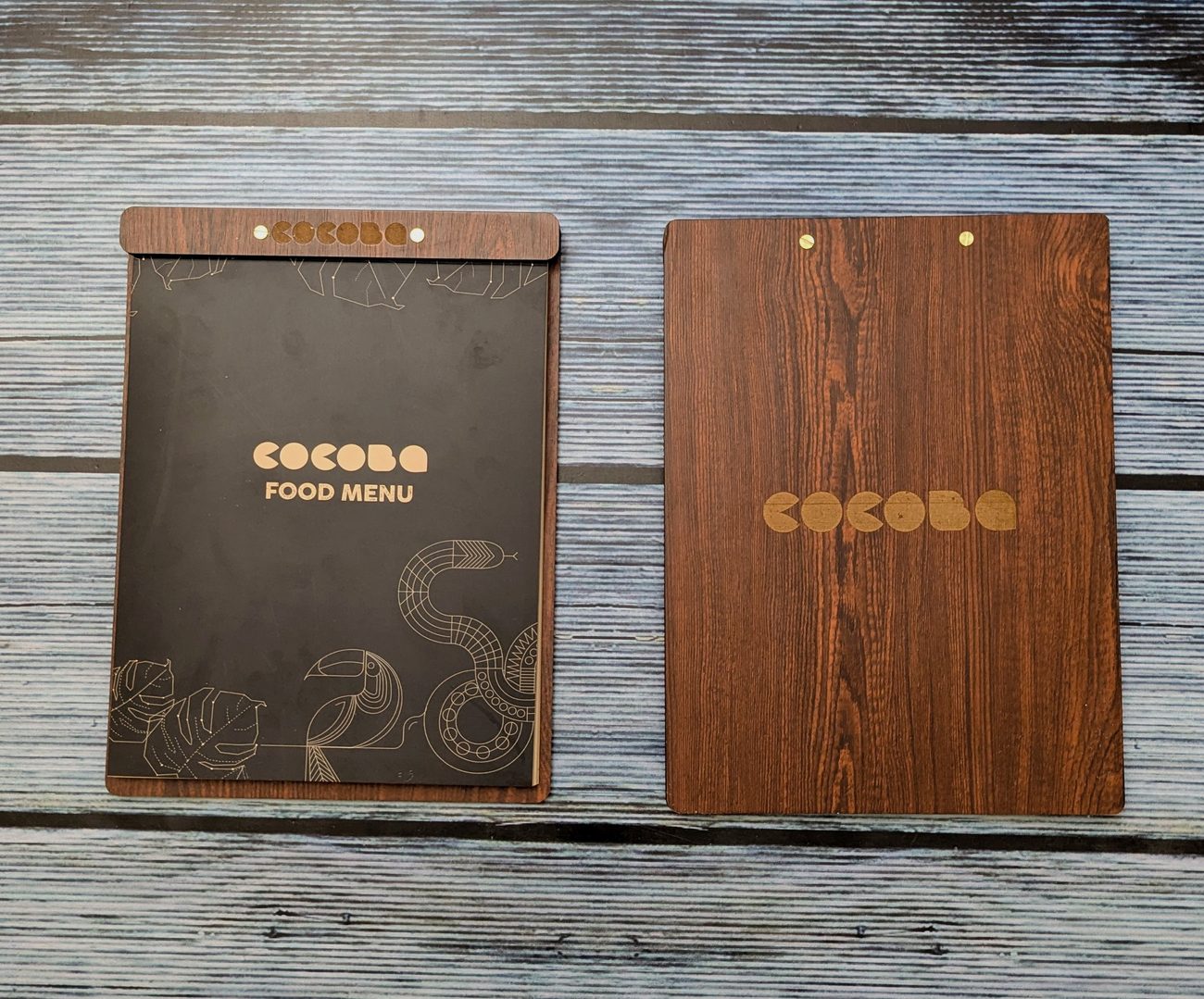
MDF menu boards and clipboard menus have quietly become the default menu for Indian cafes, casual dining rooms, bars and breweries. They look warmer than laminated paper, cost far less than solid wood, and, chosen well, let you change the menu without throwing the menu away. Chosen badly, they swell at the edges, lose their clip in a month, or lock your prices into a board you cannot update.
At RestroCart we make MDF boards, clipboard menus and paper inserts alongside uniforms and the rest of the table, so we see both the design side and what happens after six months of service. This guide covers the decisions that matter: format, engraving vs UV print, clips and bindings, thickness, finishes, and how to plan for a menu that keeps changing. If you are still choosing between materials, start with our MDF vs wooden vs leatherette comparison and come back here once MDF is on the shortlist.
MDF menu board formats, and which one fits your menu
"MDF menu" covers several quite different products. The format decides how the menu is read, how it is changed and how long it lasts, so choose it before you think about the artwork.
| Format | How the menu attaches | Best for | Changing the menu |
|---|---|---|---|
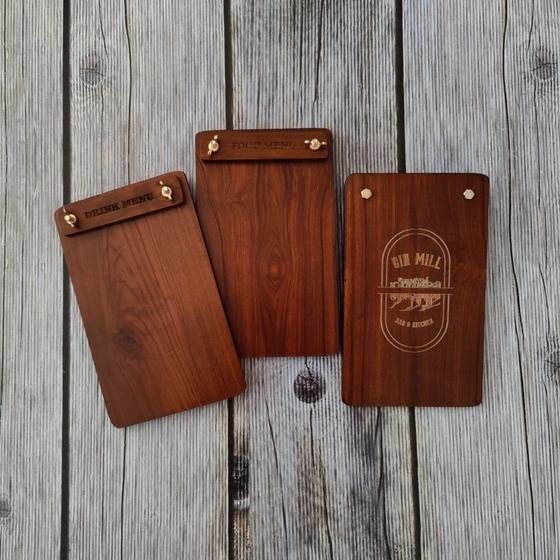
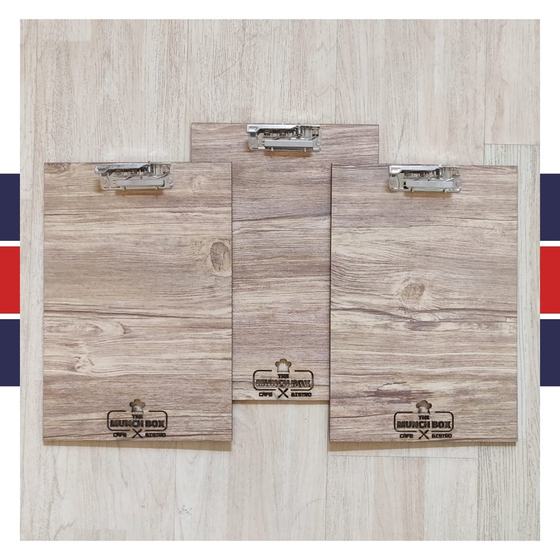
| Clipboard menu | Spring or lever clip at the top holds one or a few sheets | Cafes, breweries, daily or weekly menus | Swap the sheet in seconds |
| Screw-post header board | A strip at the top is screwed through the board and punched insert | Two to six page menus that should look bound | Unscrew, replace pages, screw back |
| Hinged book board | Two boards joined with screw posts or rings, pages inside | Full food and bar menus, many pages | Replace individual pages |
| Ring-binder board | Two or three ring mechanism on the inside cover | Long bar lists, menus in sleeves | Open the rings, swap pages |
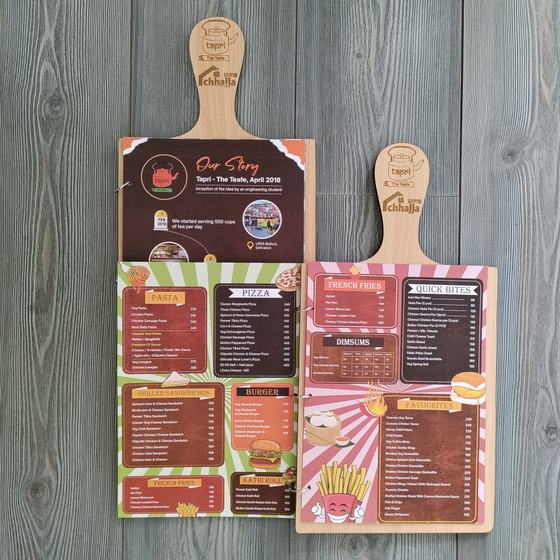
| Paddle board | Board with a handle; sheet clipped, ringed or printed on | Pizzerias, cafes, playful concepts | Depends on attachment |
| Fully printed board | Menu printed directly on the MDF | Short menus that rarely change, counters | Reprint the whole board |
The first five formats all share one idea: the board is permanent and the paper changes. That is why a clipboard or screw-post board is usually a safer choice than a fully printed one. The board carries the brand; the insert carries the dishes and prices.
Engraving vs UV print on MDF menus
This is one of the questions we are asked most often, and the honest answer is that they do different jobs.
Laser engraving
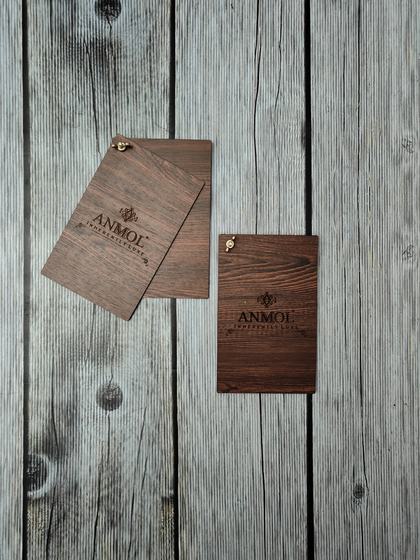
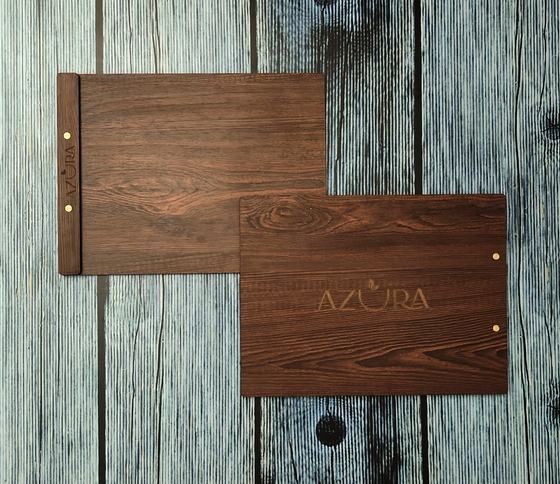
A laser burns the design into the surface. On a woodgrain-finish MDF board it cuts through the top layer and leaves a tonal mark, usually a darker brown or a lighter exposed core, depending on the board. It is permanent, cannot scratch off, and has a crafted, understated look that suits covers, back panels and header strips. The limits: it is one tone only, very fine text can lose sharpness, and it does not reproduce photographs or brand colours.
UV printing
A UV printer lays ink directly on the board and cures it instantly with ultraviolet light. You get full colour, gradients, patterns and photographs, and a white ink base lets colours hold up on dark or woodgrain boards. It is the right method when your brand colour matters, when the cover is an illustration, or when the full menu is printed on the board. Ask for a protective coat on top for table use, because printed surfaces meet cutlery, wet glasses and sanitiser every day.
Using both
The most successful boards often combine them: an engraved logo on the cover for permanence, and a full-colour printed insert inside for the menu itself. Some boards are UV printed in full colour on the front with the logo engraved on the back. Our advice is simple: engrave what should never change, print what needs colour, and put anything that will change on paper.
Clips, screw posts and rings: choosing the hardware
Hardware is where cheap menus fail first. Guests flip, twist and drop menus, and staff stack them in a hurry at closing. Choose by the number of pages you need to hold.
- One or two sheets: a clip. A lever or spring clip is the fastest to change and the cleanest look. Check that the clip is wide enough for your paper, grips firmly without tearing it, and has a finish that will not rust in a humid kitchen or near an ice well. Riveted clips last longer than glued ones.
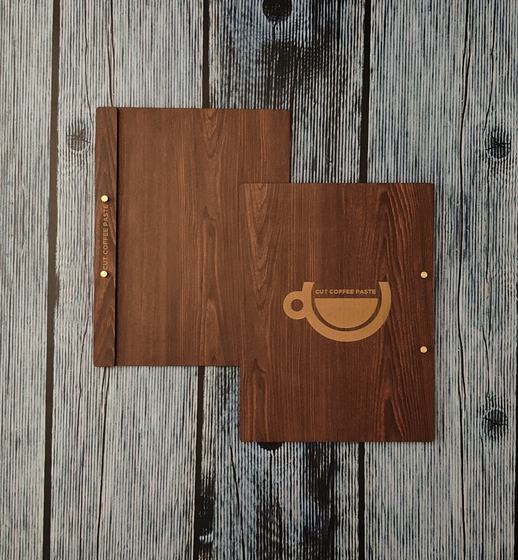
- Two to six pages: screw posts. Screw posts (sometimes called Chicago screws) pass through a header strip, the board and a punched insert. They look bound, keep pages aligned, and still let you change pages in a minute. The punch positions on your inserts must match the posts exactly, so keep the template on file.
- Many pages: rings or a hinged book. A ring mechanism on the inside cover, or two boards hinged with posts or rings, holds a full food and bar menu. Use heavier paper or sleeves so pages do not tear at the holes.
- Elastic cord. Useful for a single folded insert inside a cover board. Simple, but elastic loosens over time and should be replaceable.
Whatever you choose, ask to handle the hardware on a sample before you approve bulk production. A clip that feels fine on day one can loosen once staff start using it a hundred times a day.
Thickness and size
MDF is sold in several thicknesses. For menus, the choice is a balance between feel in the hand and weight on a crowded table.
| Board thickness | How it feels | Good for |
|---|---|---|
| About 3 mm | Light, slightly flexible | Clipboards for daily sheets, paddle boards, budget-friendly sets |
| About 4 to 5 mm | Firm, the most common choice | Handheld menu boards, header-strip boards, hinged covers |
| About 6 mm and above | Solid, noticeably heavier | Counter boards, stands, boards with deep engraving |
For size, start from the insert. A4 is the most common insert and makes printing easy anywhere; A5 suits cafes, dessert lists and bar menus; tall narrow formats work well for cocktail lists. The board should be a little larger than the insert on all sides so the paper edge is protected, with rounded corners that survive being stacked. If you already have a menu design, send it and we will size the board around it rather than the other way round.
Planning MDF or clipboard menus? Send your menu page count, insert size and logo. We will suggest a format, thickness and hardware, and share a mockup.
WhatsApp +91 98213 34906 Email info@restrocart.comFinishes that survive daily service
MDF is made of compressed wood fibres. It is stable and prints beautifully, but raw MDF absorbs water, and water on a restaurant table is guaranteed. The finish is what protects it.
- Sealed edges. The edges are the weak point, because that is where fibres are exposed. Sealed and finished edges are the difference between a board that lasts a month and one that lasts a year or two. We seal edges as standard; ask any supplier how they do it.
- Surface finish. Woodgrain laminates in walnut, teak, oak or light maple tones give a wood look at MDF prices. Solid painted colours, black especially, look sharp but show scratches sooner. Matte finishes hide fingerprints better than gloss under warm restaurant lighting.
- Protective coat over print. UV printed boards should carry a clear protective layer so the print does not wear where thumbs hold the menu.
- Hardware finish. Brass-toned, black or brushed steel clips and posts should match the board and resist rust.
For cleaning, a damp cloth with a mild detergent is enough. Never soak the boards or leave them wet, and test your sanitiser on one board before wiping the whole set with it, since strong solvents can dull some printed surfaces. Humid cities need extra care, especially coastal Mumbai and Goa, and Pune in the monsoon: store boards flat and dry, away from the dishwash area.
If your menu changes often, design for change from day one
Almost every menu changes: prices move, seasonal dishes come and go, a chef adds a special that becomes a bestseller. The mistake is discovering this after the boards are made. Plan for it instead.
- Keep prices and dishes on paper. Engrave or print only the brand on the board. A price change should cost you a reprint of paper, not a new set of boards.
- Standardise the insert size. If every menu takes an A4 or A5 sheet with the same punch positions, you can reprint at short notice from any printer. Our paper menu printing guide covers paper weights and lamination for inserts.
- Separate the fast-changing parts. Put daily specials on a small separate sheet clipped on top, or on a table card, instead of redesigning the main menu. Tent cards and table stands are made for exactly this job.
- Keep spare inserts. Inserts get stained and torn. Print a buffer with every run so a spill does not mean a missing menu on a Saturday night.
- Keep the files together. Board artwork, insert templates and punch positions should sit in one place, so the next reprint matches. We keep them on file for reorders.
MDF, solid wood, sunboard or leatherette?
MDF is not always the answer, and it is worth being clear about where it sits.
| Material | Choose it when | Read more |
|---|---|---|
| MDF board | You want a wood look, crisp branding and a friendly budget for daily use | This guide |
| Solid wood | The menu is a statement piece for a bar or fine-dine room | Wooden menus |
| Sunboard | You need light, water-resistant boards for counters, pop-ups or menus that change fully | Sunboard menu boards |
| Leatherette | The room is formal, or you need many pages in a cover that wipes clean | Leatherette menu covers |
Many restaurants mix them: MDF clipboards on the tables, a leatherette wine list for the bar, and a sunboard board at the counter. What matters is that the logo, colours and typography stay consistent across all of them.
What to send for an accurate quote
Your MDF menu brief
- Number of menus by type: food, bar, dessert, kids, and how many spares.
- Format: clipboard, screw-post header, hinged book, rings or paddle.
- Insert size and number of pages, or your current menu file.
- Cover branding: engraved, UV printed, or both, and on which side.
- Board colour or woodgrain tone, and hardware finish.
- Your logo as a vector file (AI, EPS, SVG or PDF).
- Whether you also want us to print the paper inserts.
- Delivery city and the date the menus must be in the restaurant.
Matching pieces cost little extra once the artwork is set up. Bill holders, coasters and table stands in the same board and finish make the table look designed rather than assembled; see our notes on MDF bill holders.
How RestroCart makes MDF menu boards
You send the brief on WhatsApp or email. Our in-house design team prepares mockups of the cover and insert, suggests a board tone, thickness and hardware, and sends a physical sample for approval. Production starts only after you approve the sample, every board is checked before packing, and the menus are delivered to your door anywhere in India. Design and sampling typically take two to three weeks and production two to four weeks, depending on quantity; your quote confirms the exact timeline. You can browse finished boards on our menus work page.
Ready to order MDF menu boards? Share your menu, logo and quantity. We reply the same day with a format suggestion and mockup plan.
WhatsApp +91 98213 34906 Email info@restrocart.comGet a quote. Message us on WhatsApp at +91 98213 34906, email info@restrocart.com, or build your list in our quote builder. If you are opening a new outlet, add menus to the rest of your list in the restaurant opening supplies checklist.
See the real thing: 47 wooden and MDF menu boards we have made