Style guide, Uniforms
Uniforms for Modern Indian Restaurants: Beyond the Kurta
For years the default uniform for an Indian restaurant was a kurta, maybe with a Nehru jacket for the manager. It still works, and our guide to kurta uniforms for Indian restaurants explains how to do it well. But modern Indian restaurants, from regional specialists to cocktail-led Indian bistros, increasingly want something that feels contemporary: clearly Indian, but designed for today's dining room rather than a wedding.
This guide covers modern Indian restaurant uniforms beyond the kurta: the details worth borrowing, how to use handloom texture without laundry headaches, earthy colour palettes, role-by-role ideas for kitchen, floor, bar and hosts, and how to avoid the costume look.
Why go beyond the kurta?
A kurta is a single garment, and a restaurant team is a system. Chefs need a coat that handles tandoor heat. Bartenders need an apron. Hosts need to look more polished than servers. Managers need authority. A long kurta also has practical limits on a busy floor: it catches on chair backs and trays and creases fast.
A modern Indian uniform takes the identity of Indian dress, its collars, closures, textures and colours, and applies it to the garment each role actually needs. The result reads as Indian from across the room but works like a well-designed uniform.
The vocabulary: Indian details that work on uniforms
Nehru and mandarin collars
The closed stand collar is the simplest Indian signal. On a shirt it looks crisp and removes the need for a tie; on a chef coat it looks neat at the pass. A contrast piping on the collar edge adds polish.
Angrakha-style angled closures
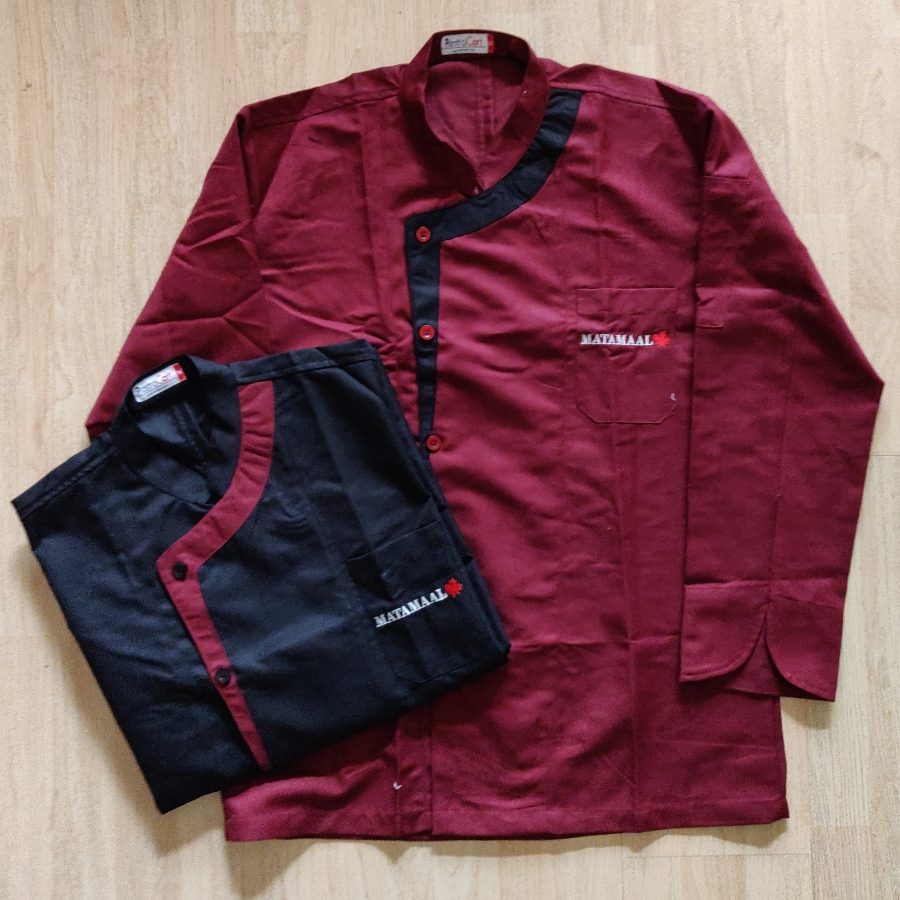
The angrakha closes with an overlapping, angled front panel. On a uniform, an angled contrast panel down the front, as on the maroon and black tunics we made for Matamaal, gives a distinctive silhouette while the garment behaves like a normal shirt or chef coat.
Bandhgala-inspired jackets
For managers, sommeliers and hosts, a jacket with a closed collar and a buttoned front is the Indian answer to the blazer. Make it in a lighter suiting weight, unlined or half-lined, so it can be worn through service. Our manager uniform guide covers fabrics and fits.
Brocade and jacquard waistcoats
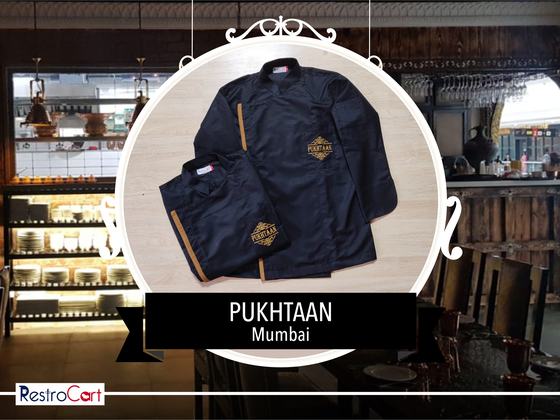
A waistcoat in a woven, brocade-look or jacquard fabric over a plain shirt instantly suggests celebration and craft, without committing the whole uniform to a heavy fabric. For Pukhtaan we paired a gold patterned waistcoat with white shirts for stewards, and made an ivory hostess tunic with red piping, so both roles share one Indian language. Our guide to waiter waistcoat styles covers cuts.
Handloom texture and printed trims
Khadi-look slubs, ikat or block-print style trims, and woven borders on plackets, pockets or apron ties bring texture and craft to an otherwise simple garment.
Earthy palettes for Indian food and interiors
Indian food is colourful, and Indian restaurant interiors often use warm woods, brass, terracotta and textiles. Uniform colours should sit comfortably in that setting and hide the inevitable turmeric, gravy and oil.
- Rust, terracotta and brick for warm, rustic and North-West Frontier concepts.
- Indigo and midnight blue for elegant, modern dining rooms; pair with sand or ivory.
- Olive, moss and bottle green for regional, farm-to-table and South Indian concepts.
- Maroon and wine for Mughlai, Awadhi and celebratory menus.
- Turmeric, mustard and saffron as bold, playful accents or casual tees.
- Sand, ivory and charcoal as neutral bases that let an accent do the talking.
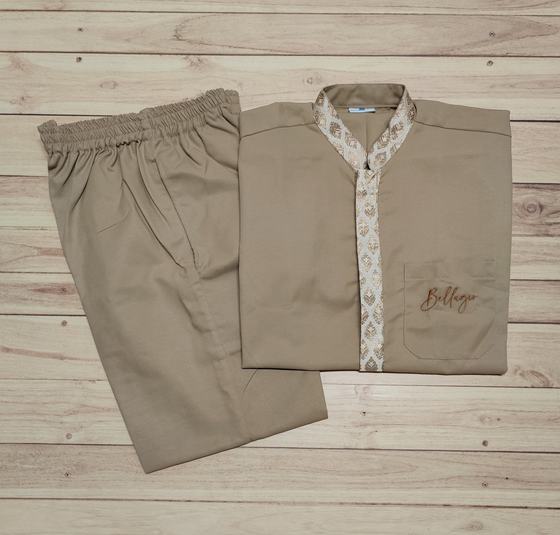
Choose one deep base and one warm accent. Use gold, copper or brass-tone embroidery for the logo, but keep it small; a little metallic goes a long way. Our uniform colour guide explains how warm lighting changes these colours.
Modern Indian restaurant uniforms by role
| Role | Modern Indian option | Fabric | Detail to borrow |
|---|---|---|---|
| Chefs / tandoor | Mandarin-collar chef coat, skull cap, apron | Breathable poly-cotton twill | Angled or contrast placket in house colour |
| Servers | Nehru-collar shirt with half apron, or shirt with brocade-look waistcoat | Poly-cotton shirting; jacquard or brocade-look waistcoat | Woven texture on the waistcoat only |
| Hosts / hostesses | Mandarin-collar tunic or short kurta-shirt with piping | Poly-cotton or poly-viscose | Contrast piping, fabric-covered buttons |
| Bartenders | Band-collar shirt with canvas or denim bib apron | Shirting; 10 to 12 oz canvas | Block-print style apron ties or trims |
| Managers | Bandhgala-inspired jacket or Nehru jacket over a shirt | Lighter suiting, half-lined | Closed collar, metallic logo embroidery |
| Housekeeping | Mandarin-collar tunic set | Poly-cotton, stain-forgiving colour | Printed or woven placket trim |
Want a modern Indian look for your team? Tell us your cuisine, interiors and roles. We will send mockups with Nehru collars, angled closures, waistcoats or handloom trims in your palette.
WhatsApp +91 98213 34906 Email info@restrocart.comHandloom: real, or handloom-look?
Handloom and khadi are a large part of the appeal of modern Indian design, and they deserve a place in the uniform. The practical question is where. Real handloom creases within an hour of service, varies from lot to lot, and can shrink or bleed colour in a commercial laundry. That makes it hard to reorder in six months and hard to keep looking fresh on twenty servers.
The approach we usually recommend:
- Main garments in a handloom-look or slub-texture poly-cotton blend that washes and irons easily.
- Real handloom, brocade or block-print fabric for small elements: waistcoats, collar facings, pocket trims, apron ties, a manager's jacket.
- Colour testing of any real handloom before bulk, with a wash test at your laundry's temperature.
For kitchen fabric specifically, our chef coat fabric guide explains blends and weights for tandoor and curry sections.
Regional identity without the clichés
India is not one cuisine, and the most interesting modern Indian restaurants are proudly regional: Kashmiri, Chettinad, Malabar, Bengali, Awadhi, Parsi, Goan, Punjabi, Rajasthani, North-East. The uniform can carry that identity quietly, through choices that locals recognise and first-time guests simply find beautiful.
- Colour borrowed from the region. Deep reds and saffron for Rajasthani menus, the off-white and gold of Kerala's kasavu for Malabar and South Indian concepts, indigo and white for coastal kitchens, rich maroon and green for Mughlai and Awadhi rooms.
- A textile reference, used small. A kasavu-style border on an apron tie, an ikat-look trim on a pocket, a block-print facing inside a collar, a phulkari-inspired embroidered motif as the logo surround.
- A silhouette cue. A short, angled closure nods to the angrakha; a straight, closed collar to the bandhgala; a wrap-tie apron to a dhoti or mundu drape.
- Language. A word or phrase in the regional script, embroidered on the back of a jacket or across an apron bib, can say more than any graphic. Have the script checked by a native reader before it is digitised.
What to avoid: costume headgear, sherwanis and full ethnic dress on service staff, unless the concept is genuinely ceremonial. They are hot, hard to launder and often make staff feel like props rather than hosts. One detail per garment, repeated across the team, is enough to tell the story.
Modern Indian done casually
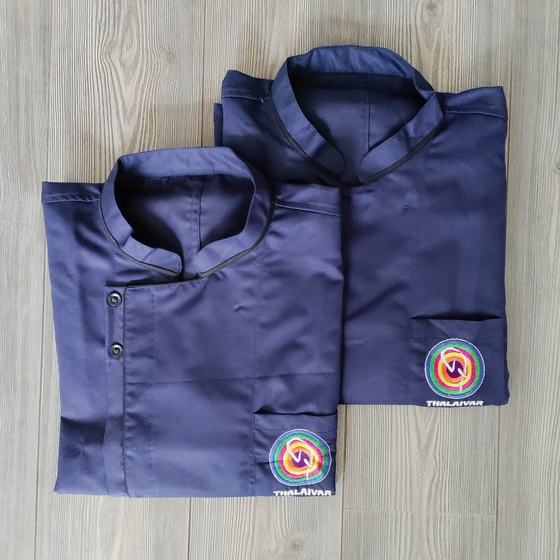
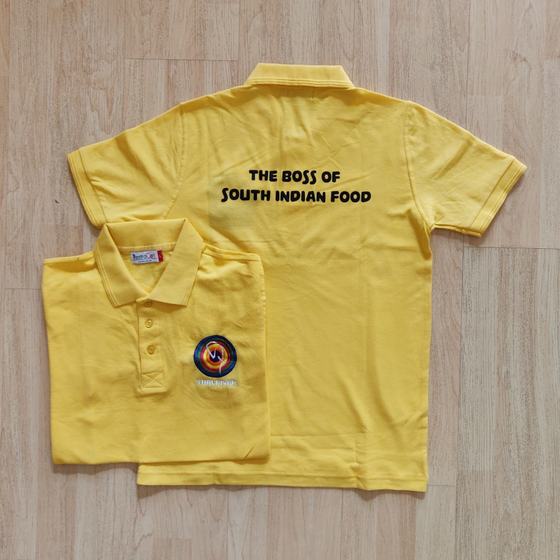
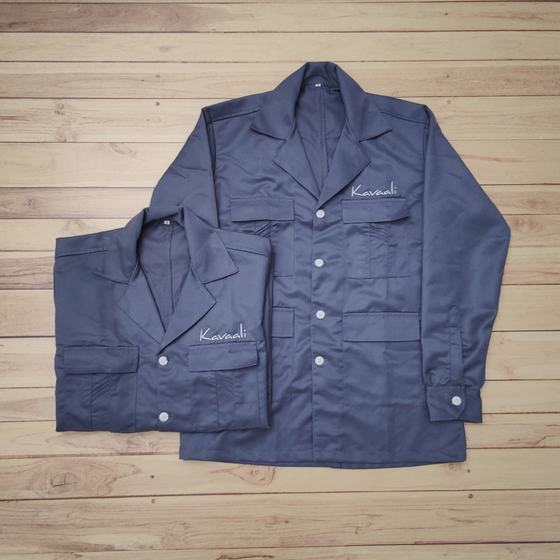
Not every modern Indian restaurant is formal. Casual regional cafes, chaat bars and street-food concepts can express the same identity through colour, language and graphics on tees and polos. For Thalaivar we made bright yellow polos printed with "The boss of South Indian food" and a round logo at the chest, alongside navy blazers for managers. For Kavaali we made grey jackets with button-flap pockets and script embroidery, alongside black and charcoal polos and caps with the script logo. A safari or utility jacket in an Indian palette is another strong casual option; see our guide to safari shirts and overshirts.
Avoiding the costume look
Modern Indian uniform checklist
- Use one Indian detail per garment: a collar, a closure, a texture or a trim.
- Keep lengths practical for service; mid-hip or upper thigh rather than knee length.
- Put heavier or woven fabrics on waistcoats and jackets, not on everything.
- Pick one deep base and one warm accent, and repeat them across roles.
- Keep metallic embroidery for logos and small details.
- Test real handloom or printed trims in your laundry before bulk production.
- Give the kitchen the same palette so the pass and the floor look connected.
- See a full sample set per role under your restaurant's lighting before approving.
How RestroCart makes modern Indian uniforms
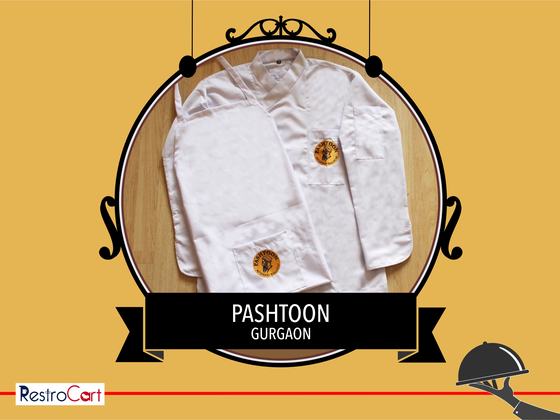
We have made uniforms for Indian restaurants including Pukhtaan, Matamaal, Thalaivar and Kavaali. The process is the same for every client: share your cuisine, interiors, roles and logo on WhatsApp or email; our in-house design team sends mockups and suggests fabrics, colours and branding; you approve swatches and a sample set; then we produce, quality-check and deliver to your door anywhere in India, packed by role or size. Typical timelines are two to three weeks for design and sampling and two to four weeks for production. Patterns, fabric codes and artwork stay on file so reorders match, whether you are adding two servers next month or opening a second outlet next year. Browse more in our client portfolios.
Ready to design a contemporary Indian uniform? Send your logo, cuisine and roles. We reply the same day with ideas and a sampling plan.
WhatsApp +91 98213 34906 Email info@restrocart.comMessage us on WhatsApp at +91 98213 34906, email info@restrocart.com, or build your list in our quote builder.