Buying guide, Uniforms
How Custom Restaurant Uniforms Are Made: The Brief-to-Doorstep Process, Step by Step
For most restaurateurs, the uniform order is a black box. You send a logo on WhatsApp, some weeks pass, and a carton arrives. When it goes well, nobody thinks about the process. When it goes badly, it is usually because a decision that should have been made in week one was made in week five, or not at all.
This guide opens the box. It walks through the seven stages of a custom uniform order as we run them at RestroCart in New Delhi, what happens at each one, what you need to decide, and how long it takes. Whether you order from us or anyone else, knowing the stages will help you plan your opening and ask better questions.
The timeline at a glance
| Stage | What happens | Your input | Typical time |
|---|---|---|---|
| 1. Brief | Roles, headcount, brand files, budget and deadline are shared | Logo, colours, roles, date | 1 to 2 days |
| 2. Design | Mockups per role: cut, colour, branding placement | Feedback on mockups | 3 to 5 days |
| 3. Swatches | Physical fabric and thread swatches are sent | Choose fabric and shade | 3 to 5 days |
| 4. Sample | One complete set per role is stitched and branded | Try on, wash-test, approve | 5 to 8 days |
| 5. Production | Fabric cut, stitched, embroidered or printed in bulk | Final size list | 2 to 4 weeks |
| 6. Quality check and packing | Every piece checked, packed by name or size | Delivery address, contact | 2 to 3 days |
| 7. Delivery and reorders | Doorstep delivery anywhere in India; spec sheet kept on file | Reorder quantities when needed | Transit time plus days for reorders |
Put together, the first four stages take roughly two to three weeks and production takes two to four weeks, which is where the four-to-seven-week range comes from. Large multi-role orders, winterwear and anything ordered between October and December sit at the longer end.
Stage 1: The brief
A good brief is the difference between a first mockup that is nearly right and three rounds of guessing. The essentials are short:
- Roles and headcount: how many chefs, commis, stewards, bartenders, hosts, housekeeping staff and managers.
- Brand assets: your logo, ideally as a vector file (AI, EPS, SVG or PDF), plus brand colours.
- The feel: a few reference images, your interiors, or simply three words that describe the place.
- Budget range: per set or overall, so options are realistic from the start.
- Deadline: the date the uniforms must be in the building, not the opening date.
We have turned this into a one-page restaurant uniform brief template you can copy and fill in.
Stage 2: Design mockups
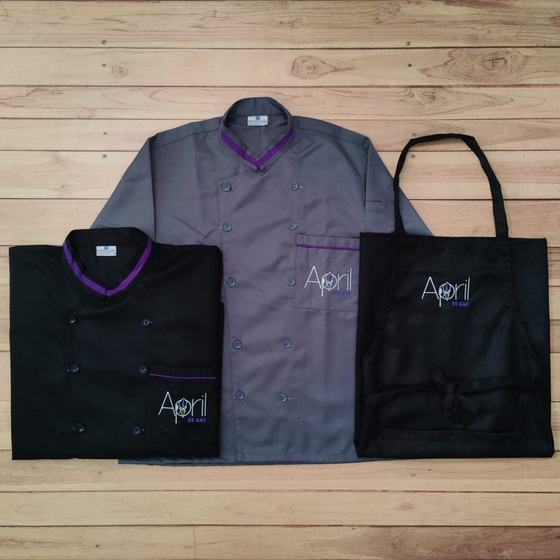
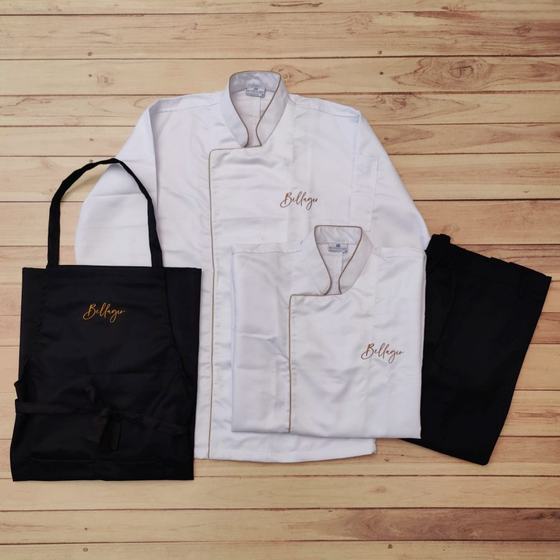
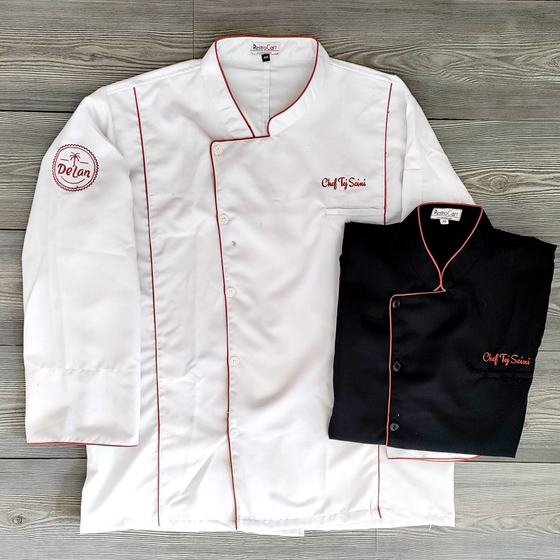
Our design team, led by co-founder Vasudha Gupta, turns the brief into mockups for each role. A mockup settles the decisions that are hard to change later: garment style (chef coat or chef tee, shirt or polo, bib or half apron), colour blocking and piping, where the logo sits and how large it is, and whether there is a secondary message, like a line on the back of a tee or a word on an apron strap.
This is the cheapest stage to change your mind. Ask for alternatives here. Once a sample is stitched, every change costs time.
Tip: judge mockups as a group, side by side, not role by role. The goal is a uniform system where each role is distinct but clearly from the same brand, which we explain in our role-by-role uniform guide.
Stage 3: Fabric and colour swatches
Screens lie about colour. A maroon that looks perfect on a phone can look brown under warm restaurant lighting, and black fabrics vary more than people expect. That is why we send physical swatches of fabric and embroidery thread before sampling.
This is also where fabric weight gets decided. A 210 GSM poly-cotton twill for chef coats, a 180 to 220 GSM pique for polos, a heavy cotton canvas for aprons: each choice changes how the uniform feels, how it washes and what it costs. If the numbers are new to you, our chef coat fabric guide and apron fabric comparison cover the trade-offs.
Look at swatches in your restaurant, under your lighting, next to your furniture. Five minutes there prevents most colour regrets.
Stage 4: The physical sample
The sample is one complete set per role, made in the chosen fabric with the actual branding. It is the most important checkpoint in the whole process, because what you approve here is what gets made in bulk.
How to check a uniform sample
- Put it on the person who will wear it, and have them work in it for an hour.
- Check the colour next to your interiors and under your lighting.
- Look closely at embroidery: no puckering, clean edges, correct size and placement.
- Check pocket positions against real use: pen, notepad, thermometer, card machine.
- Wash it once or twice the way your laundry will, then check shrinkage and colour.
- Confirm the size run you need, including any ladies' fits and larger sizes.
Only approve when you are happy. If something needs to change, a revised sample is far cheaper than a reprinted batch.
Planning an opening? Tell us your date and team size. We will map the design, sampling and production timeline backwards from your opening day.
WhatsApp +91 98213 34906 Email info@restrocart.comStage 5: Production
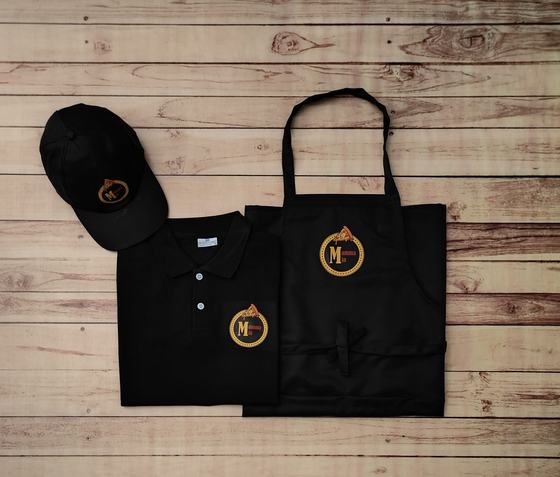
After sign-off, fabric is issued for your order, cut to graded patterns and stitched. Branding happens either before stitching (on cut panels, for some embroidery placements) or after (on finished garments). For most restaurant orders, production takes two to four weeks, depending on quantity, the number of different garments and the embroidery load.
During production you need to send one thing: the final size list. The cleanest way is a simple sheet with each person's name, role and size. If staff are still being hired, order a size run with 10 to 15 percent spare and distribute on arrival. Our sizing guide covers spare ratios by role.
Stage 6: Quality check and packing
Every piece is checked before it leaves: measurements against the size spec, embroidery placement and finish, loose threads, stains, buttons and press studs. Pieces are then packed the way you want them to arrive. For a new opening, packing by staff name saves your manager an afternoon of sorting. For a chain, packing by outlet and role makes distribution simple.
Stage 7: Delivery, and every order after it
We deliver to the door anywhere in India, from Delhi NCR and Gurgaon to Amritsar, Jaipur, Srinagar, Guwahati, Kolkata, Pune, Bengaluru and Goa. For out-of-town clients, the whole process above runs over WhatsApp, video calls and courier; see how we deliver uniforms across India.
The order is not really finished at delivery. The first reorder, usually within three to six months as the team changes, is the real test. We keep a spec sheet for every client: fabric, shade, thread colours, embroidery files, placements and size grading. That is what makes the fifth steward's shirt match the first one.
Planning backwards from your opening date
Restaurant openings slip, but uniform lead times do not shrink to match. Here is a simple backward plan for a new outlet.
| Weeks before opening | What should be done |
|---|---|
| 8 weeks | Brief sent; roles and headcount estimated; budget agreed |
| 7 weeks | Mockups reviewed and finalised |
| 6 weeks | Fabric swatches approved under your lighting |
| 5 weeks | Samples received, worn, washed and approved |
| 5 to 2 weeks | Production; final size list sent |
| 2 weeks | Delivery; distribution and trial wear during training and soft launch |
| Opening day | Team in uniform, spares on the shelf |
The two-week buffer before opening is not a luxury. Staff need to wear the uniform during training so you can fix fits, add a missing size or order a few more aprons before guests arrive. Our new restaurant checklist lists every uniform and supply item by department.
Where orders go wrong, and how to avoid it
- Starting too late. The most common problem by far. Start eight weeks out.
- Skipping the sample. Fabric, colour and fit problems that a sample would have caught become problems across the whole batch.
- Changing the design after sampling. Small changes restart the clock. Make them at the mockup stage.
- Guessing sizes. A size set or a measurement guide takes a day and saves a reorder.
- Ordering winterwear in November. Fleece lead times are longer and every north Indian restaurant orders in the same window. Our winterwear guide suggests ordering in September or October.
- Splitting uniforms across vendors. Two suppliers means two shades of your brand colour. There is a case for one supplier for uniforms and supplies.
Why the process matters more than the price
Two quotes can look similar per piece and produce very different results, because the difference is in the steps: whether swatches are sent, whether a sample is made, whether embroidery is checked, whether specs are kept. When you compare suppliers, compare their process as carefully as their price. Our guide on choosing a restaurant uniform manufacturer has fifteen questions to help.
Start with a brief, finish with a team that looks the part. Send your roles, headcount and date. We reply the same day with next steps.
WhatsApp +91 98213 34906 Email info@restrocart.com